
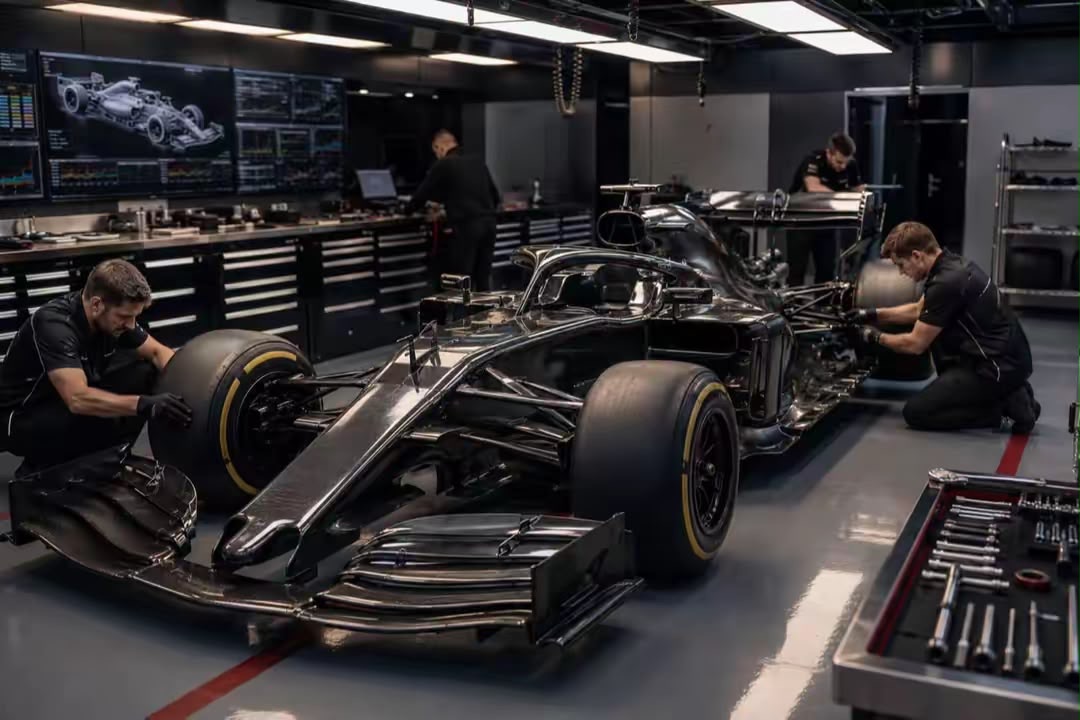
On a Formula One car, idling is when the engine is running, but the car is not moving. No acceleration. No forward movement. Just the engine alive, running, and maintaining its operating state.
Unlike ordinary road cars, F1 cars have a very high idle speed, often around 3,000 to 5,000 RPM, depending on the engine generation and setup.
Mechanically, idling in an F1 car involves a delicate balance. The engine must maintain sufficient speed and stability while the car is stationary. Its electronic control systems monitor and manage various engine functions, while the anti-stall system helps prevent the engine from dying when the driver comes to a stop.
Modern F1 power units are also extremely sophisticated. They require careful preparation before starting, including preheating their fluids and using external starting equipment. Their operating temperatures and cooling requirements are carefully managed.
Unlike ordinary road cars, F1 cars depend heavily on airflow through their radiators and cooling systems. When stationary, they cannot rely on the same natural airflow they experience at racing speeds. This is why teams use external cooling equipment when necessary and avoid leaving the engines running unnecessarily for extended periods.
Even when the car is not moving, a lot is happening beneath the surface.
Idling also serves a purpose. It allows the team to monitor the car’s systems, check telemetry, and ensure that everything is functioning as expected before the car returns to the track.
You don’t simply push an F1 car hard without making sure everything is ready for the demands of racing.
That’s where solitude, peace, and inner calm when not in motion come in. Idling in mental health awareness.
Embracing and enjoying solitude is an important indication of emotional growth and healing. Most people find it difficult to stay still. They are constantly in motion, prompted by distractions, ambitions, responsibilities, and the need to keep themselves occupied.
It becomes very difficult to notice that something is wrong when we are always moving, unless something obvious happens to interrupt that movement.
Others push themselves hard straight from the cold, without allowing themselves sufficient time to prepare emotionally and mentally for the demands of life.
At times, we find it difficult to maintain the delicate balance where everything within us is active, yet there is no outward progress.
This is where solitude becomes important.
It is where we probe our motivations, intentions, and desires. It is where we examine what is happening within us and intentionally choose not to channel every thought, feeling, or desire into immediate action.
We learn that not every feeling requires a response, not every desire requires fulfilment, and not every opportunity requires us to move.
Sometimes, the greatest progress happens when we are not moving.
An F1 car’s systems are constantly monitored, even when it is stationary. Similarly, mental health awareness encourages us to pay attention to our internal systems.
A good F1 mechanic can identify potential problems by examining the car’s telemetry and listening to how the engine runs. Mental health awareness trains us to become good mechanics of our own emotional well-being.
We learn to identify irregular rhythms, emotional misfires, internal knocking, and hesitation.
We become more aware of anxiety, unhealthy motivations, unresolved emotions, restlessness, and the things that might otherwise go unnoticed when we are constantly occupied.
We learn to make the necessary adjustments before returning to the demands of life.
However, there is another important lesson from F1.
Idling cannot be sustained indefinitely.
An F1 car is designed to race. Remaining stationary for too long while its engine is running can create cooling challenges. It needs the right conditions to maintain its operating state.
Similarly, solitude is not about withdrawing permanently from life or avoiding responsibilities. It is about finding healthy periods of stillness that allow us to examine ourselves, restore balance, and prepare for meaningful engagement with life.
The true test of peace, the true test of healing, and the true test of growth is not simply how well we perform when everything is moving.
It is also how well we maintain our inner balance when nothing is moving.
Solitude. Peace. Inner calm. When not in motion.
Are you peaceful while idling?
F1 And Mental Health.